
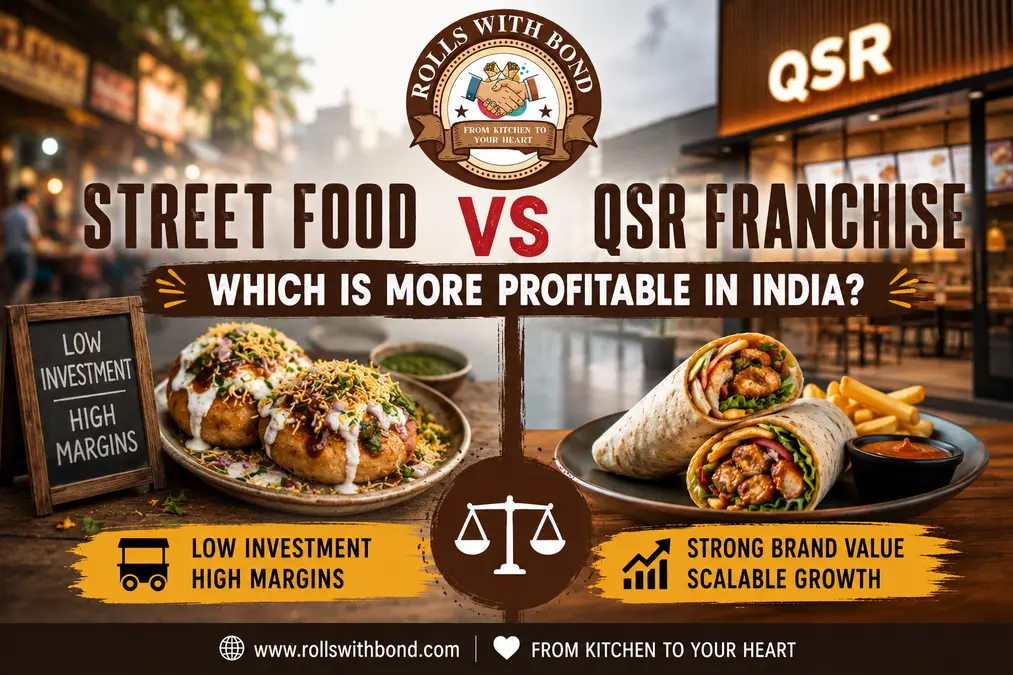
Street Food vs QSR Franchise: Which is More Profitable in India?
Today, we are here to look at two very similar business models, but at the same time, they are very different. In the recent past, some global events have had a tremendous and lasting impact on the world, and India is no exception. People are now taking up their careers as entrepreneurs more seriously, and this has raised the number of startups and businesses across the country. You may observe a significant increase in the Street Food business as well as in the low-cost food franchise.
Understanding the Difference Between Street Food and QSR Franchises
Street food is an independent, hyper-local food model sold from a cart, kiosk, or food truck with minimal setup and maximum flexibility. In most of the cases it’s like the owner and worker are the same person . A QSR (Quick-Service Restaurant) franchise is a standardised, established brand operating out of a dedicated commercial space with structured operations, stringent rules, and broader market reach. This will make a QSR franchise a scalable model where multiple branch can be opened in the same city or district, whereas a street food cart has limited scope or no scope for scalability.
Initial Investment Comparison: Street Food Stall vs QSR Franchise
| Street Food Business | QSR Franchise | |
| Initial Investment | Low (₹2–₹5 Lakh for a cart/kiosk) | High (₹10–₹50+ Lakh for built-out units) |
| Setup & Space | Carts, stalls, or food trucks need high-traffic pedestrian areas. | Commercial spaces (food courts, high streets); dine-in or delivery-focused. |
| Brand Recognition | Relies on local reputation and word-of-mouth. | Uses established brand identity, marketing, and loyal customer base. |
| Operations & Menu | High flexibility; owners control ingredients, recipes, and daily pricing. | Highly standardised; recipes, portion sizes, and supply chains are dictated by the brand. |
| Profit Margins | Can achieve higher percentage margins due to ultra-low overhead. | Slightly lower percentage margins but often generates massive sales volume. |
| Break-Even Timeline | Typically faster (6–12 months). | Typically slower (18–36 months). |
Profit Margins and ROI: Which Business Model Earns More?
Street Food earns higher margins mainly due to Low overhead costs. The Cost of raw material also plays a vital role; no royalties or franchise fees allow the vendor to keep 100% earnings
A typical street food vendor generally earns between 25% and 50% net profit margins, and their annual ROI falls between 25% and 45%.
QSR franchises require commercial space, whether dine-in or delivery-focused; they use standardised raw material. This increases the cost and puts pressure on the margins. But being a brand will get customers trust and stable footfall. QSRs are also trusted by customers on apps like Swiggy and Zomato, allowing them to scale much larger sales volumes. Thus, despite their low profit margins, they generate larger revenue than a stationary street cart.
QSR food franchises in India can get a net profit margin between 20% and 30% with annual ROI ranges between 25% and 35%. With high sales volumes, QSR food franchises are expected to earn more, and they have the ability of scalability too.
Brand Value and Customer Trust in QSR Franchises
Put yourself as a customer. Where would you prefer to have an outing with family and kids? Nothing is hidden about how most of the street food vendors do not follow basic hygiene, from quality of raw materials to process of manufacturing and cleanliness of surroundings. Now on the other hand, if you find a QSR franchise with clean interiors and properly dressed staff, where will you prefer to go? You will prefer to go to a safe and hygienically clean place with your family and kids. As a customer, a brand brings trust with it. Quality not only matters to a customer, but it also has more importance for a brand, as this is what we can say is the lifeblood for a brand.
Customers are more inclined towards a QSR franchises for their brand value.
Operational Challenges: Managing a Street Food Business vs Franchise
It’s very easy to start a street food business – no paperwork required and no regulations; it’s just a one-man show. Anyone can start it one fine day with a bare minimum investment. On the other hand, a QSR franchise requires lots of work before starting.
Both business face operational challenges.
| Area | Street Food Business | QSR Franchise |
| Procurement | Manual Sourcing: Every single day, you personally go to the mandi, or local markets. Price fluctuations and inconsistent quality constitute risks. | Centralised Sourcing: Vetted, exclusive suppliers are supplied by franchisors. This offers no flexibility but guarantees lower costs through bulk purchasing. |
| Manpower | High Turnover: Frequently depends on one or two individuals. The business might stall when they leave. There’s no formal training. | Professional Training: SOPs and training courses are offered by brands. Although systems speed up onboarding, high staff turnover remains a problem. |
| Regulations | Informal to Basic: For turnover up to ₹1.5 Cr, basic FSSAI registration is needed. There is more limited inspection. | Complex Licensing: Shop & establishment registrations, GST, fire safety NOC, and FSSAI licences must all be kept up to date. subject to regular company audits. |
| Marketing | Owner-Driven: You maintain your own Zomato and Swiggy listings as well as social networking presence. | System-Driven: While marketing is usually handled centrally, you continue to pay monthly marketing fees, which usually range from 1 to 3 per cent. |
| Ease | High: Depending on local demand or ingredient costs, you can rapidly alter recipes, prices, or menus. | Zero: Without corporate approval, you cannot add even one dish. The brand sets prices either nationally or locally. |
Marketing and Growth Opportunities in Both Models
Street food vendors are hugely dependent on the spread of word of mouth; they usually don’t spend on marketing, but high-contrast signage help them to attract local customers near them. local food bloggers sometimes play a role in marketing of a street food vendors like Baba Ka Dhaba. By consistent updation of Google Business Profile, they keep themselves discoverable in local searches.
On the other hand, QSR franchises need structured, organised marketing campaigns. Targeted ads on Google and Meta, point-based loyalty programmes for customer retention, and push notifications through mobile apps. QSR franchises are scalable on a national and international basis, and street food vendors are mostly restricted to local markets with no or very little scope of scalability.
Who Should Choose a Low-Cost Food Franchise in India?
Honestly, anyone can go for a low-cost food franchise in India. But we have seen a trend and found the following profile more inclined towards this business model.
New Entrant in Business: People with no prior experience in the food business. They get support from Brand from the starting to commissioning of the project, training, SOP, and marketing support.
Salaried People: Who are looking for a side income where they don’t have time, but they have money to start a business and they get support from the brand to start a QSR franchise.
Small business from tier-2 & tier-3 cities: This is a great diversification strategy for local company owners because of the growing need for branded, sanitary food in smaller communities.
Final Verdict: Street Food or QSR Franchise—Which Is More Profitable in India?
Due to greater fixed expenses and royalties (3%–6%), QSRs have a smaller percentage margin, but their overall income is much higher. Independent stalls seldom generate monthly revenues of ₹5–15 lakhs per outlet.
Delivery services like Zomato and Swiggy are more suited for QSR franchises. Delivery and takeaway are predicted to make up more than 60% of the QSR business by 2026. By reaching customers far beyond their physical location, this enables franchisees to “out-earn” street food.
Low-cost QSR franchises (investment: ₹5–10+ lakh). The long-term cash flow and scalability are better for creating a multi-unit business, even though the wait for profit is slightly longer. Entrepreneurs with a limited investment budget can compare these formats with other food franchise options under ₹10 lakhs.
Comments