
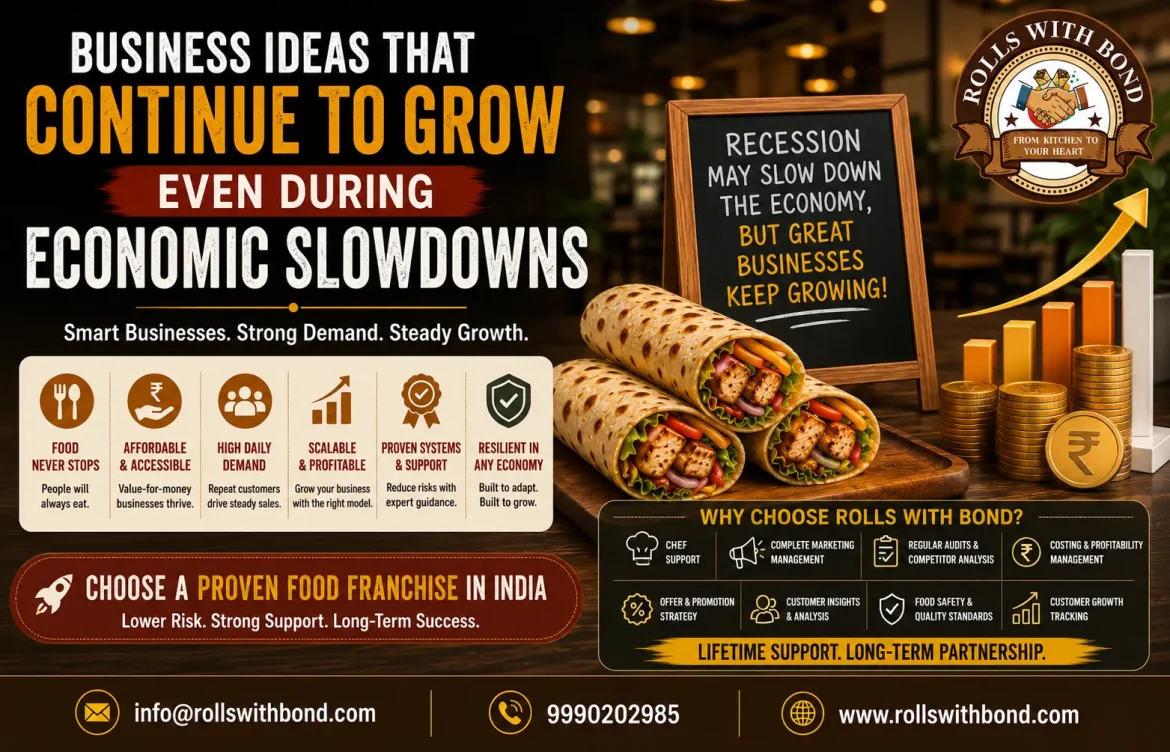
Business That Grow Even During Economic Slowdowns
Economic slowdowns can create uncertainty for entrepreneurs, investors, and small business owners. When consumer spending becomes cautious, many people postpone major purchases, reduce discretionary expenses, and think carefully before investing in a new business.
However, an economic slowdown does not mean that every business stops growing.
History has shown that certain business categories remain relatively resilient because they serve regular, practical, or affordable consumer needs. People may delay buying a new car, renovating their home, or purchasing luxury products, but they still need food, healthcare, essential services, repairs, and other everyday products.
For aspiring entrepreneurs, this creates an important opportunity.
Instead of asking, “Which business is growing fastest right now?”, a better question may be:
“Which businesses can continue attracting customers even when the economy becomes challenging?”
In this article, we explore ideas about business that grow even during economic slowdowns and can remain relevant, why affordable food businesses, particularly a well-structured Food Franchise in India, can be an attractive option for entrepreneurs looking for a proven and scalable business model.
1. Affordable Food and Quick-Service Businesses
Food is one of the most consistent areas of consumer spending. While customers may reduce spending at expensive restaurants during difficult economic periods, they still look for convenient, affordable, and satisfying meals.
This is one reason quick-service restaurants (QSRs) can remain attractive during economic uncertainty.
Affordable food businesses can benefit from several consumer behaviours:
- People continue purchasing everyday meals and snacks.
- Customers may shift from premium dining to value-for-money options.
- Office workers and students continue looking for convenient food.
- Delivery and takeaway create additional sales channels.
- Affordable menu items can encourage repeat purchases.
A well-positioned Food Franchise in India can benefit from these patterns by offering products that are convenient, reasonably priced, and suitable for frequent consumption.
The key is not simply selling food. The business must offer the right combination of taste, price, consistency, hygiene, and convenience.
A food franchise can be considered by entrepreneurs looking for an established food-business model. Those working with a defined budget can explore food franchise options under ₹10 lakhs.
2. Grocery and Daily-Need Businesses
Businesses selling everyday necessities tend to remain relevant because customers cannot completely eliminate these purchases.
Examples include:
- Grocery stores
- Dairy products
- Household essentials
- Personal care products
- Basic packaged food
During a slowdown, consumers may switch brands or choose more affordable products, but the underlying need remains.
The challenge with this category is often competition. Grocery and daily-need businesses may operate with relatively thin margins, so location, purchasing efficiency, and inventory management become extremely important.
3. Repair and Maintenance Services
Economic uncertainty often changes consumer behaviour from “replace” to “repair.”
Instead of purchasing a new phone, appliance, vehicle, or piece of equipment, customers may prefer to repair their existing items.
This can create opportunities in businesses such as:
- Mobile repair
- Vehicle servicing
- Appliance repair
- Computer maintenance
- Home maintenance
These businesses can benefit from repeat demand because products and equipment require regular servicing regardless of economic conditions.
4. Affordable Healthcare and Wellness Services
Healthcare needs generally do not disappear during an economic slowdown.
Affordable and accessible services can therefore remain relatively resilient.
Potential categories include:
- Diagnostic services
- Pharmacies
- Physiotherapy
- Basic wellness services
- Preventive healthcare
However, entrepreneurs entering healthcare-related businesses must carefully understand licensing, regulations, professional qualifications, and compliance requirements.
A business may have strong demand but still face significant challenges if regulatory requirements are not properly managed.
5. Education and Skill Development
Economic slowdowns often encourage people to improve their skills.
Employees may seek additional qualifications to improve job security, while students may invest in training that increases their employment opportunities.
Business opportunities can include:
- Professional skill training
- Language training
- Computer education
- Vocational courses
- Online learning support
- Career development services
The strongest opportunities usually solve a clear problem and provide measurable value to customers.
Why Affordable Food Businesses Can Be Resilient
Among the various business opportunities available, affordable food businesses have one significant advantage: food consumption is frequent and recurring.
Customers may not need a salon service every day or purchase a new product every week, but meals and snacks are recurring needs.
During challenging economic conditions, customers may become more selective. They may ask:
- Is the food worth the price?
- Is the portion sufficient?
- Is the quality consistent?
- Is the outlet hygienic?
- Are there attractive offers?
- Can I order conveniently?
This creates opportunities for businesses that understand local customer behaviour.
A successful food outlet does not need to be the most expensive or the cheapest. It needs to deliver value that matches its target market.
Why a Food Franchise in India Can Reduce Some Business Risks
Starting an independent food business requires an entrepreneur to build almost everything from scratch.
This includes:
- Creating a brand
- Designing the menu
- Developing recipes
- Hiring chefs
- Training employees
- Finding suppliers
- Managing marketing
- Creating operational systems
- Understanding food costing
For a first-time entrepreneur, managing all these responsibilities can be challenging.
A structured Food Franchise in India can reduce some of this complexity by providing an established business framework.
However, not every franchise offers the same level of support. Before investing, entrepreneurs should carefully evaluate what happens after the outlet opens.
This is where ongoing support becomes an important factor.
What Should You Look for in the Best Food Franchise in India?
The Best Food Franchise in India is not necessarily the franchise with the biggest name or the highest number of outlets.
For an investor, the better question is:
“What support will I receive when I face a business problem?”
A strong franchise model should ideally provide clarity around:
1. Operational Support
The franchisor should have standard operating procedures to maintain consistency.
2. Marketing Support
Opening an outlet is only the beginning. Continuous marketing is needed to generate awareness and attract customers.
3. Staff and Chef Support
Food quality depends heavily on the people preparing the food. Recruitment, training, and chef management can become major challenges for new entrepreneurs.
4. Costing and Profitability Management
High sales do not automatically mean high profits. Food costs, wastage, labour expenses, and promotions must be monitored.
5. Local Market Understanding
Customer behaviour differs from one location to another.
An offer that works in a college area may not work in a residential neighbourhood.
How Rolls With Bond Focuses on Long-Term Partnership
One important consideration when evaluating a food franchise is whether the franchisor’s relationship with the franchisee ends after the outlet launch.
At Rolls With Bond, the focus is on building long-term business partnerships through its Lifetime Support Model.
The idea is to help franchise partners manage and optimize their outlets continuously rather than leaving them to handle every challenge independently.
The support model includes several important areas.
Chef Support
Finding and retaining skilled chefs can be a major challenge in the food business.
Rolls With Bond supports franchise partners with the hiring, training, and management of chefs. The franchise partner is responsible for providing the chef’s food, salary, and accommodation.
This can help reduce the operational burden associated with managing kitchen staff.
Complete Marketing Management
Marketing is essential, particularly during periods when customers become more cautious with spending.
Support includes strategy, execution, local campaigns, and brand positioning to help outlets remain visible and relevant.
Competitor Analysis
The competitive environment around an outlet can change over time.
Regular competitor analysis helps identify local market changes and opportunities for improvement.
Time-to-Time Audits
Operational standards can gradually decline if they are not regularly monitored.
Periodic audits can help identify problems early and maintain consistency.
Costing and Profitability Management
During an economic slowdown, cost control becomes even more important.
Smart management of food costs, wastage, and operating expenses can have a direct impact on margins.
Offer and Promotion Strategy
Different customers respond differently.
Some markets are price-sensitive, while others focus more on quality or convenience.
Offers can be designed according to local customer behaviour rather than applying the same strategy everywhere.
Customer Insights and Analysis
Understanding customers is critical for business survival.
Analysing whether customers are price-sensitive, quality-driven, or offer-driven can help an outlet make better decisions about pricing, products, and promotions.
Food Safety and Quality Standards
Customers may forgive a small delay, but repeated quality or hygiene issues can damage a business quickly.
Maintaining consistent food safety and quality standards helps build trust and encourages repeat orders.
Customer Growth Tracking
Long-term growth depends on both attracting new customers and retaining existing ones.
Tracking new versus repeat customers can provide valuable insight into the health of the business.
Importantly, Rolls With Bond states these support commitments clearly in its agreement, providing franchise partners with greater transparency about the relationship and available support.
The Importance of Value-for-Money During Slowdowns
When money becomes tighter, customers do not necessarily stop spending. Instead, they become more careful about where they spend.
This creates a significant advantage for businesses that provide clear value.
For a Low Cost Food Franchise in India, value can be created through:
- Affordable menu options
- Consistent quality
- Convenient locations
- Fast service
- Attractive combo offers
- Reliable delivery
- Good customer experience
The goal should not always be to offer the lowest price.
Extremely low pricing can damage profitability.
Instead, successful businesses create a perception that customers are receiving good value for the amount they spend.
Low Investment Can Help Manage Business Risk
A lower initial investment can provide an important advantage during uncertain economic conditions.
When an entrepreneur invests a very large amount, the business needs to generate sufficient profits to cover operating costs and recover the initial investment.
A Low Cost Food Franchise in India may reduce the financial pressure associated with starting a business, provided the business model has realistic sales and profitability potential.
However, entrepreneurs should look beyond the franchise fee.
The complete investment may include:
- Franchise fees
- Interior setup
- Kitchen equipment
- Rent deposit
- Licences
- Initial inventory
- Staff expenses
- Working capital
- Marketing
Always calculate the total investment and maintain sufficient working capital for the initial months.
How to Choose a Business During an Economic Slowdown
Before investing in any business, ask these important questions:
Is There Regular Customer Demand?
Businesses based on recurring needs can provide more stability than businesses dependent on occasional purchases.
Is the Business Affordable for Customers?
During slowdowns, affordable products and services may attract a wider customer base.
Does the Business Have Strong Unit Economics?
Understand how much profit is generated from each sale after accounting for direct and operating costs.
Can the Business Adapt?
A flexible business can respond to changing customer preferences and market conditions.
Is There Ongoing Support?
For first-time entrepreneurs, expert guidance can help avoid costly mistakes.
Is the Investment Appropriate for Your Financial Capacity?
Never invest all available savings without considering working capital and personal financial responsibilities.
Economic Slowdowns Can Also Create Opportunities
While many people see an economic slowdown only as a threat, it can also create opportunities.
Lower consumer spending forces businesses to become more efficient.
Weak competitors may exit the market.
Customers may actively search for better value.
Entrepreneurs who understand these changes can position their businesses effectively.
The strongest businesses are often not those that simply grow during good times. They are the ones that learn how to manage costs, retain customers, and adapt when conditions become challenging.
Final Thoughts
Economic slowdowns can make entrepreneurship more challenging, but they can also reveal which business models are truly sustainable.
Businesses built around essential needs, affordable products, recurring demand, efficient operations, and strong customer relationships are generally better positioned to navigate difficult periods.
For entrepreneurs exploring business opportunities, the food sector can be particularly interesting because customers continue looking for convenient and affordable meals even when they become more cautious with their spending.
The key is choosing the right model.
A successful Food Franchise in India requires more than a popular menu or attractive branding. Long-term success depends on market demand, location, cost control, customer understanding, marketing, food quality, and operational discipline.
When looking for the Best Food Franchise in India, investors should therefore evaluate the complete support system—not just the initial investment amount.
For entrepreneurs seeking a Low Cost Food Franchise in India, a model that combines affordable entry with ongoing operational, marketing, chef, and profitability support can help reduce some of the challenges involved in building a business from scratch.
With the right business model, strong customer demand, and a committed long-term support system, a food franchise can offer an opportunity to build a business designed not only to grow during good economic times but also to adapt and remain competitive when the market becomes challenging.